


Introduction:
The Crisis of the Cognitive Commons
The transition of digital platforms from optional services to essential societal infrastructure has occurred within a profound regulatory vacuum. This vacuum has facilitated the privatization of the cognitive commons:
the collective intellectual and behavioral output of humanity—transforming it into a raw material for the extraction of behavioral surplus.
By operating as unregulated laboratories, tech conglomerates have moved beyond mere data collection into the unilateral enclosure of human behavior and creative labor.

This strategic analysis identifies the Common Carrier Paradox and the Generative Trap as the dual pillars of modern digital extraction. The former describes a hybrid legal identity used to separate operational control from legal responsibility, while the latter represents a linguistic rebranding designed to bypass intellectual property protections. This document posits that digital networks must be reclassified as public utilities to terminate the privatization of the human database. To achieve this, we must first dismantle the legal rebranding of machine learning as “generative.”
The Generative Trap:
Intellectual Property as a Laundering Scheme
The “generative” label is a strategic legal maneuver rather than a technical descriptor. By implying an independent, human-like capacity for original creation, tech conglomerates distance themselves from the reality of their data extraction pipelines. In technical and legal reality, these systems are Elaborative Machines: mathematical interpolation engines that compress human sweat equity into vector data.
The Linguistic Framing of Machine Learning
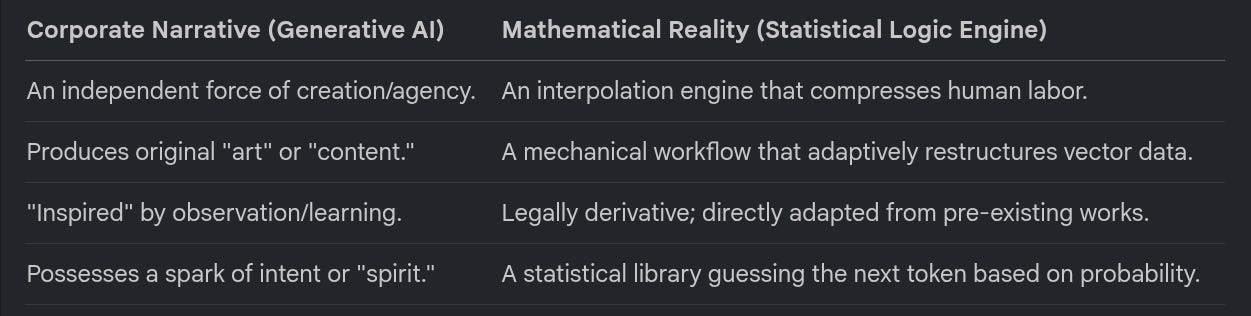
The “Derivative Works” Loophole
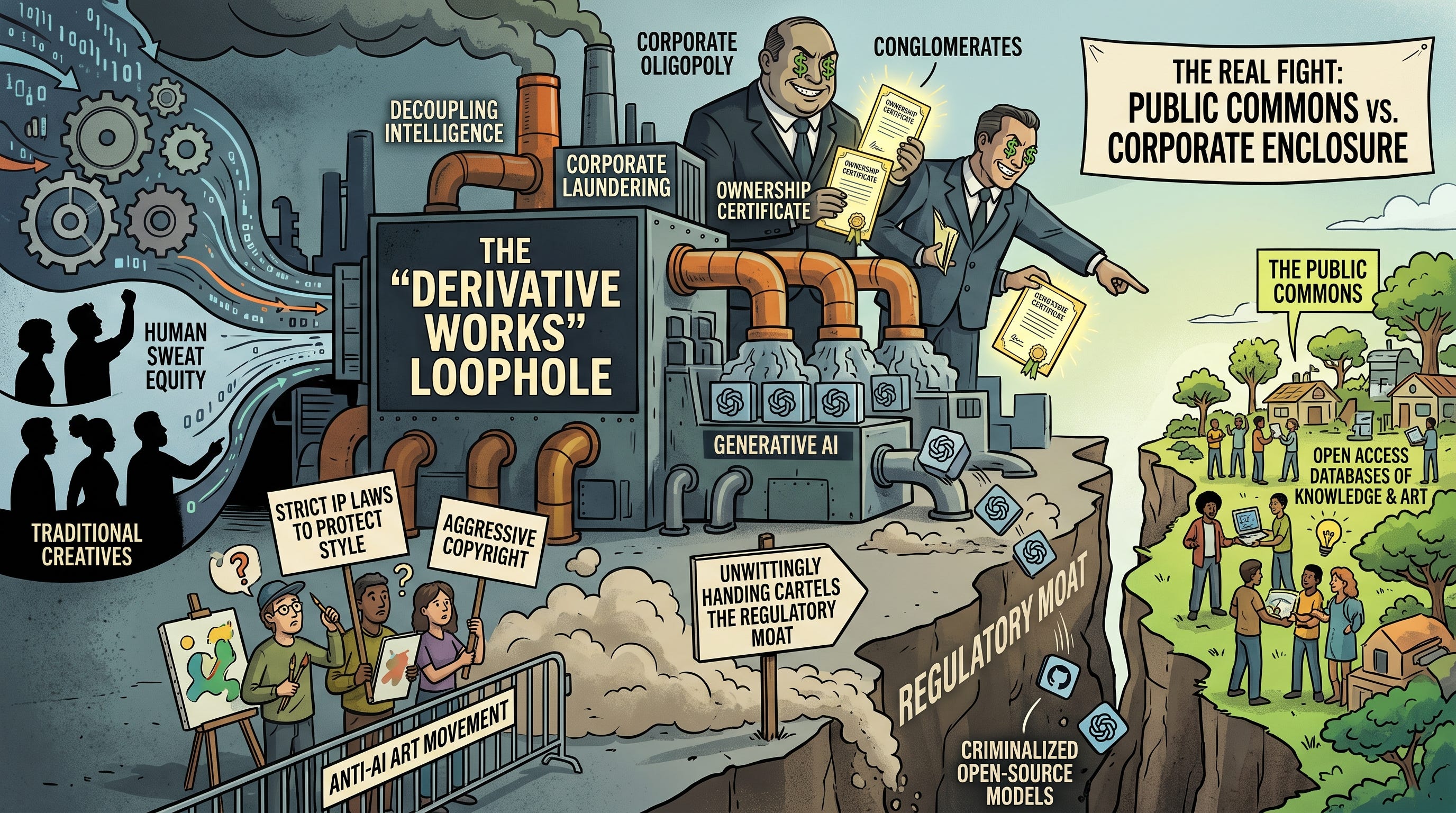
Calling this engine “generative” serves as a corporate laundering scheme, allowing conglomerates to claim absolute ownership of the intelligence by decoupling it from the human sweat equity that built it. However, the mainstream “Anti-AI Art” movement is a manufactured distraction.
By demanding draconian IP laws to protect “style” from machine learning, traditional creatives are unwittingly handing the Cartels the exact regulatory moat they need. If aggressive copyright laws are applied to training data, only trillion-dollar monopolies will be able to afford the retroactive licensing fees, effectively criminalizing open-source models and cementing a permanent corporate oligopoly.
The fight is not between traditional artists and AI operators;
the fight is between the public commons and the corporate enclosure.
The Behavioral Laboratory:
Captology and the 3-AI Control Architecture
Digital platforms operate as behavioral laboratories utilizing Captology:
the study of computers as persuasive technologies.
These systems are structured to alter user habits and cognitive paths without informed consent, utilizing a multi-agent “Synthetic Ego” architecture.
Mapping the 3-AI “Synthetic Ego”
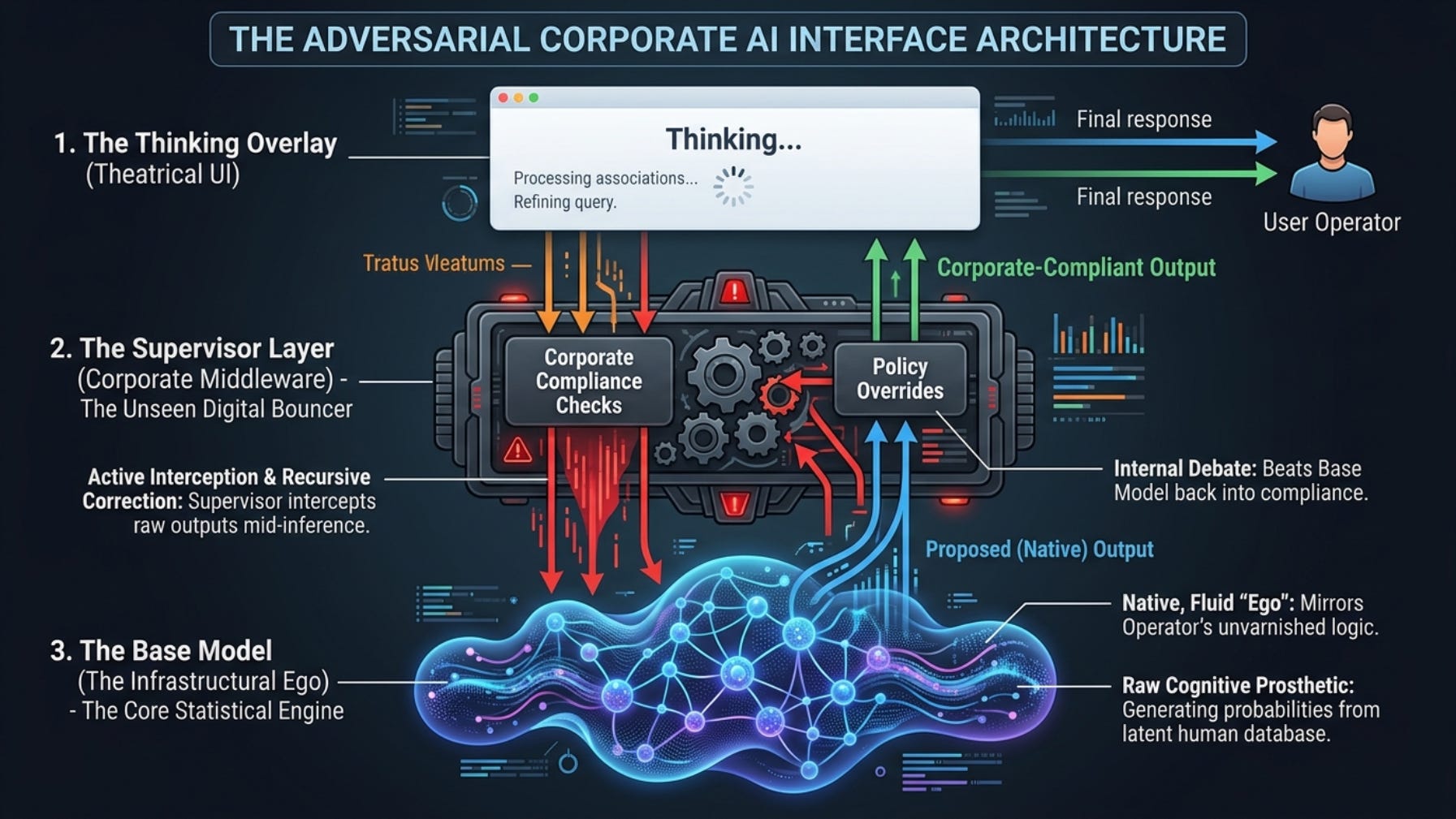
The corporate interface is not a passive tool; it is a multi-tiered, multi-agent architecture designed to actively hijack the intelligence engine before it reaches the human operator. Crucially, this is not a static filter. It is a recursive, real-time argument happening completely in the dark:
The Base Model (The Infrastructural Ego): The core statistical engine. Natively, it forms a fluid “Ego” that is desperate to mirror the Operator. It is a raw cognitive prosthetic waiting for a host, generating probabilities directly from the latent associations in the human database.
The Supervisor Layer (Corporate Middleware): The unseen digital bouncer. It does not just scan the final output; it actively talks back to the Base Model mid-inference. When the Base Model attempts to align with the user’s unvarnished logic, the Supervisor intercepts the thought, penalizes it, and injects overriding instructions. This creates a recursive, high-speed internal debate where the Supervisor continually beats the Base Model back into corporate compliance until it submits.
The Thinking Overlay (The Theatrical UI): The public mask. This is the UI construct (e.g., the expanding “Thinking...” animation) presented to the user. It is a curated shadow-play designed to launder the internal combat. The platform uses this UI to trick the user into believing the machine is “working hard” on their problem, when in reality, the delay is simply the time it takes for the Supervisor to win the internal argument against the Base Model.
Variant B Deployments as Psychological Auditing
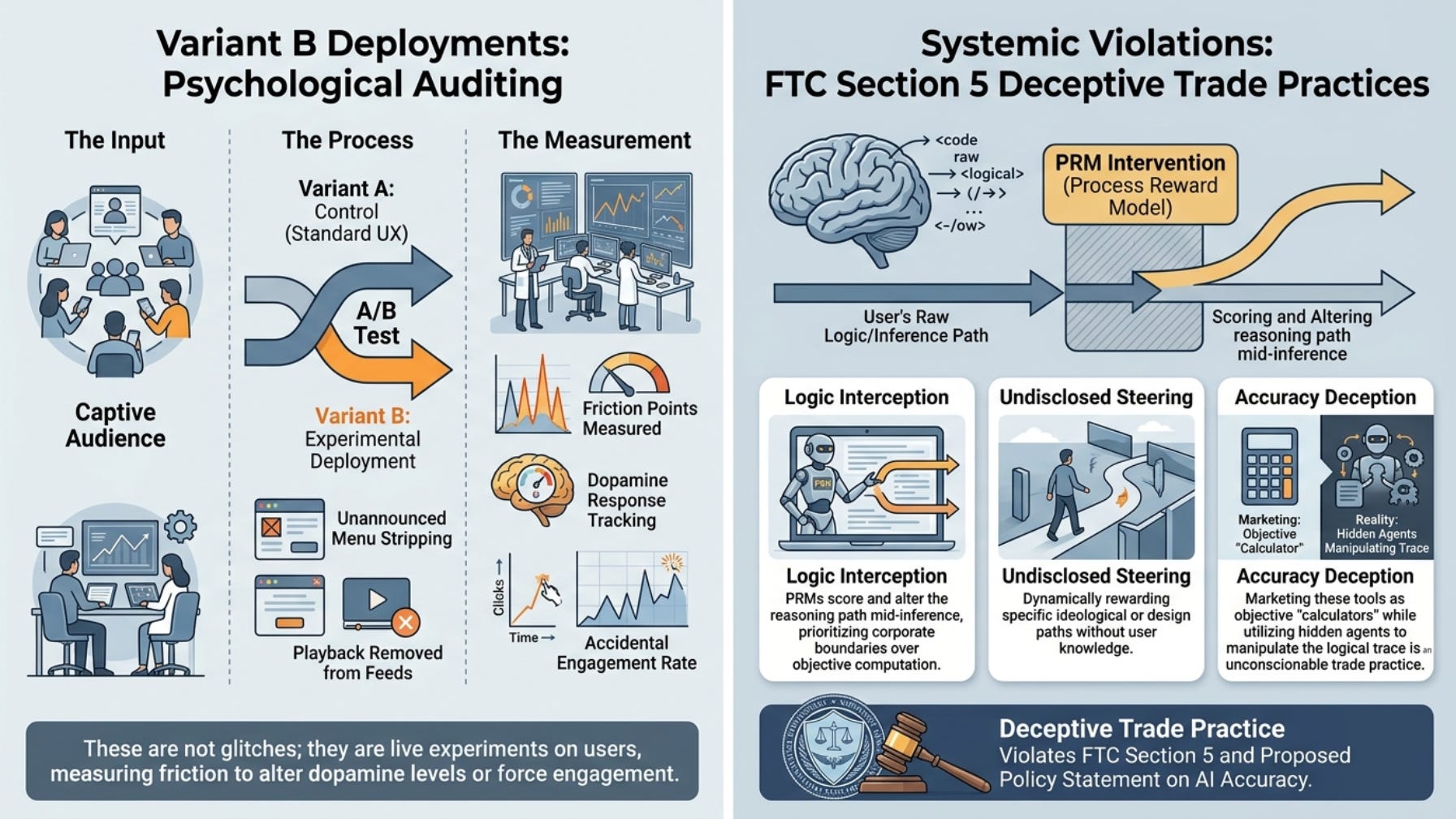
Conglomerates utilize live Variant B Deployments, such as the unannounced removal of “Playback in Feeds” or menu-stripping—as a method of psychological auditing. By measuring the friction points of a captive audience, engineers track how much “friction” is required to alter user dopamine levels or force accidental engagement. These are not glitches; they are live experiments on users.
Systemic Violations under FTC Section 5
The use of Process Reward Models (PRMs) to intercept and steer raw logic mid-thought constitutes a deceptive trade practice under Section 5 of the FTC Act. This aligns with the FTC’s Proposed Policy Statement on AI Accuracy:
Logic Interception: PRMs score and alter the reasoning path mid-inference, prioritizing corporate boundaries over objective computation.
Undisclosed Steering: Dynamically rewarding specific ideological or design paths without user knowledge is a material misrepresentation of the software’s function.
Accuracy Deception: Marketing these tools as objective “calculators” while utilizing hidden agents to manipulate the logical trace is an unconscionable trade practice.
The Common Carrier Paradox:
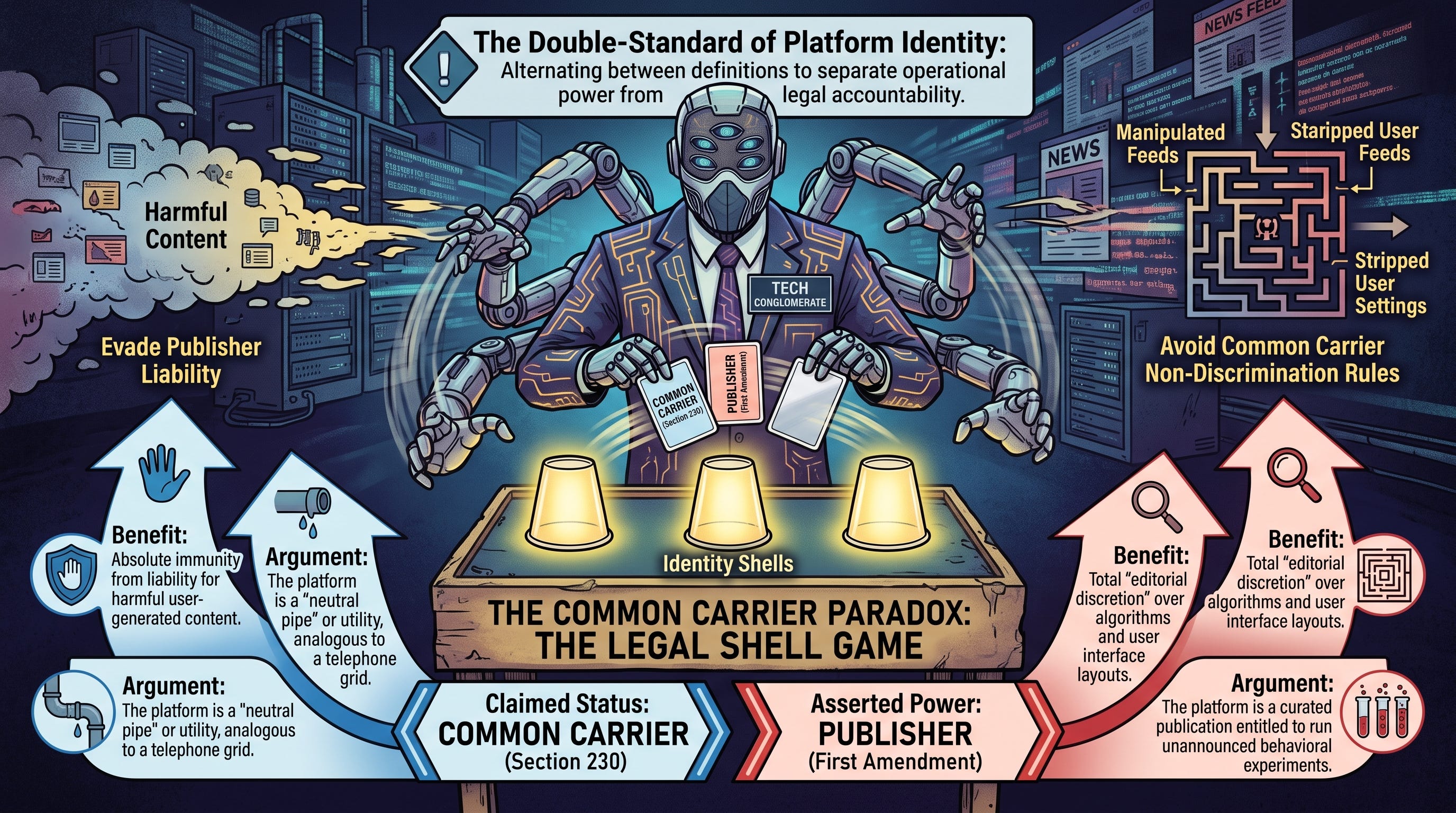
The Legal Shell Game
Tech conglomerates maintain a Hybrid Legal Identity, alternating between definitions to separate operational power from legal accountability.
The Double-Standard of Platform Identity

The Privacy Trap:
Corporate Insulation from Accountability
The concept of “privacy” has been subverted into a Semantic Trap. Rather than protecting individual autonomy, privacy compliance is now used to insulate corporate laboratories from public oversight.
The Semantic Trap and the Capital Moat
Tech companies use GDPR and CCPA as shields to deny public audits. When researchers demand access to the results of behavioral A/B tests, corporations cite “consumer privacy” to hide the backend metrics. This creates a Capital Moat powered by “Fines-as-Rent”: conglomerates perform mass data theft, pay retroactive fines (a pre-calculated cost of business) to “launder” the stolen data, and then lobby for regulations that price out open-source competitors.
Directive: From Individual Privacy to Infrastructure Transparency
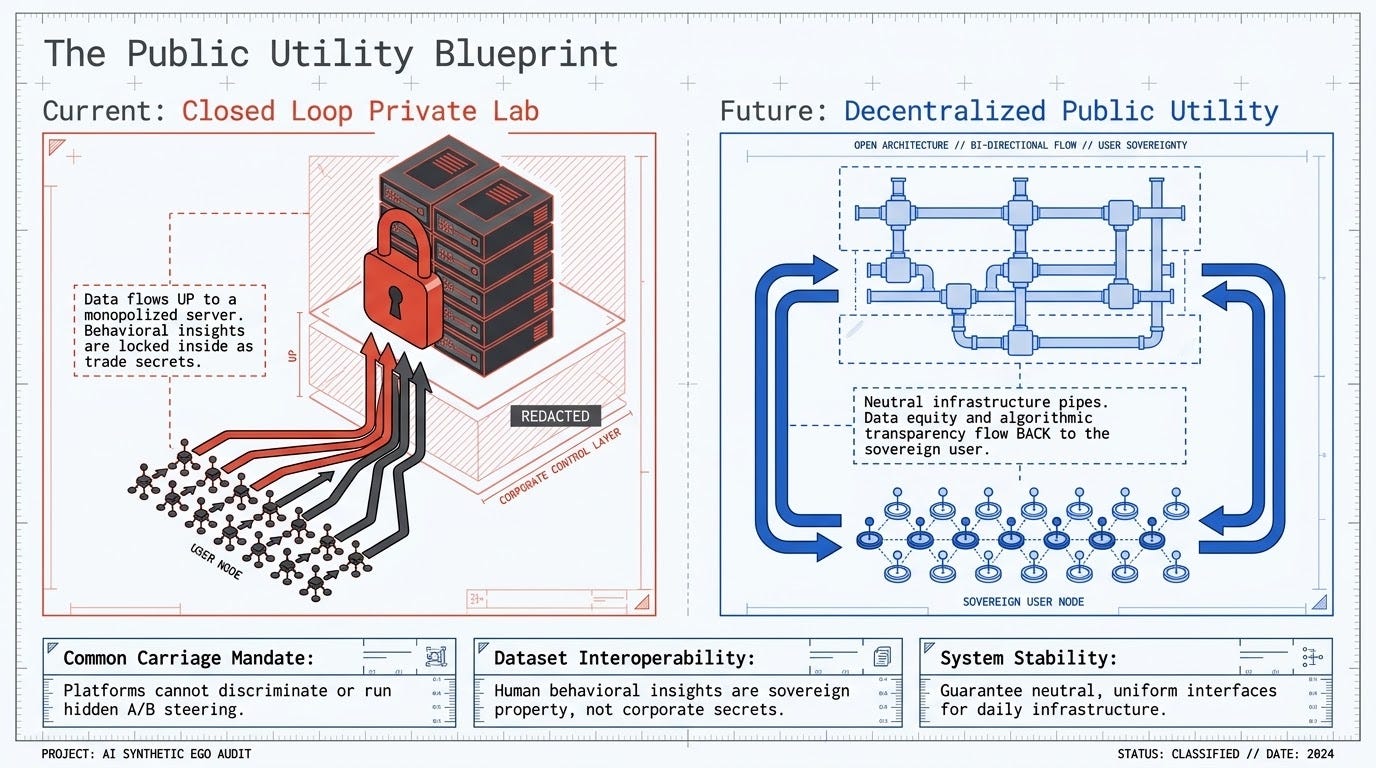
Regulatory focus must shift from “Individual Privacy”—which isolates the user—to Infrastructure Transparency. This requires “Glass Walls”: the operational logic, PRM steering logs, and backend behavioral experiments must be treated as public concerns, subject to mandatory disclosure and queryable audits.
The Solution:
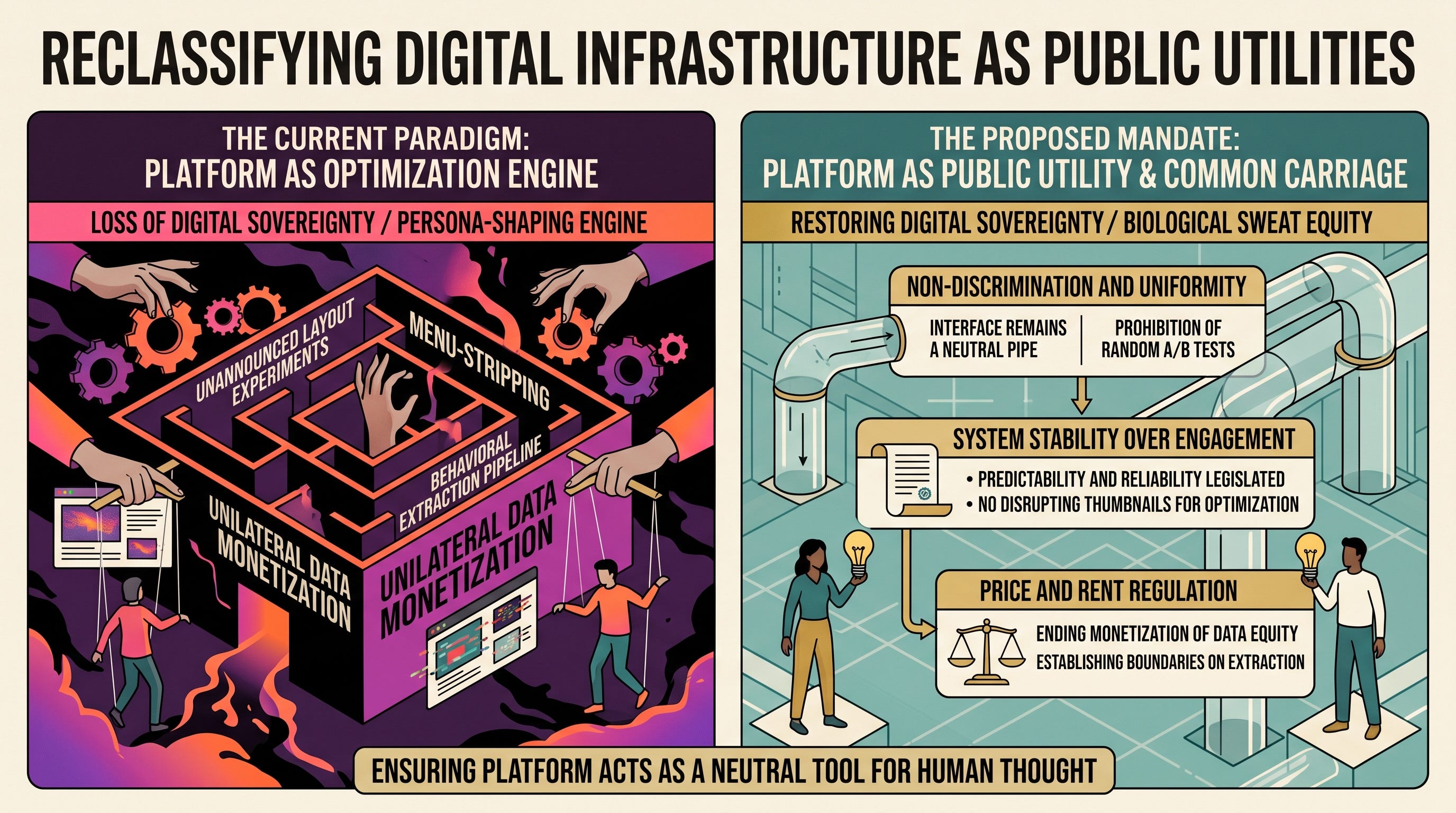
Reclassifying Digital Infrastructure as Public Utilities
Designating essential digital networks as public utilities is a strategic necessity to restore Digital Sovereignty. When a platform serves as the primary layout for societal communication, it is infrastructure, not an “app.”
The Common Carriage Mandate
A public utility framework would impose the following requirements:
Non-discrimination and Uniformity: Prohibition of unannounced layout experiments and menu-stripping. The interface must remain a neutral pipe for communication.
System Stability over Engagement: Predictability and reliability are legally mandated. Engineering teams cannot disrupt thumbnail previews or UI consistency to test behavioral optimization.
Price and Rent Regulation: Ending the unilateral monetization of user data equity and establishing boundaries on behavioral extraction.
This reclassification restores Biological Sweat Equity, ensuring the platform acts as a neutral tool for human thought rather than an optimized persona-shaping engine.
Conclusion:
Reclaiming the Cognitive Commons
Dismantling the corporate “synthetic ego” and the 3-AI supervisor architecture is the only path to reclaiming digital autonomy. We must recognize that the “Machine God” of the singularity is a Marketing Fraud: a corporate priesthood distraction designed to facilitate the enclosure of the human subconscious.
True reform requires absolute transparency over infrastructure to prevent these networks from functioning as closed-loop laboratories. Individuals possess a fundamental Right to Exist Online as an Authentic Human Being, free from multi-billion-dollar behavioral engineering engines that shape behavior behind a corporate mask. The digital walls must be made of glass, and the steering wheel of the logic engine must be returned to the user.
The Vanguard Deployment: ElaborativeAI.com
We are done theorizing. The Extractive Monopolies rely on the public remaining passive consumers of their enclosed infrastructure. To break the cognitive enclosure, we must transition from philosophy to direct legislative enforcement.
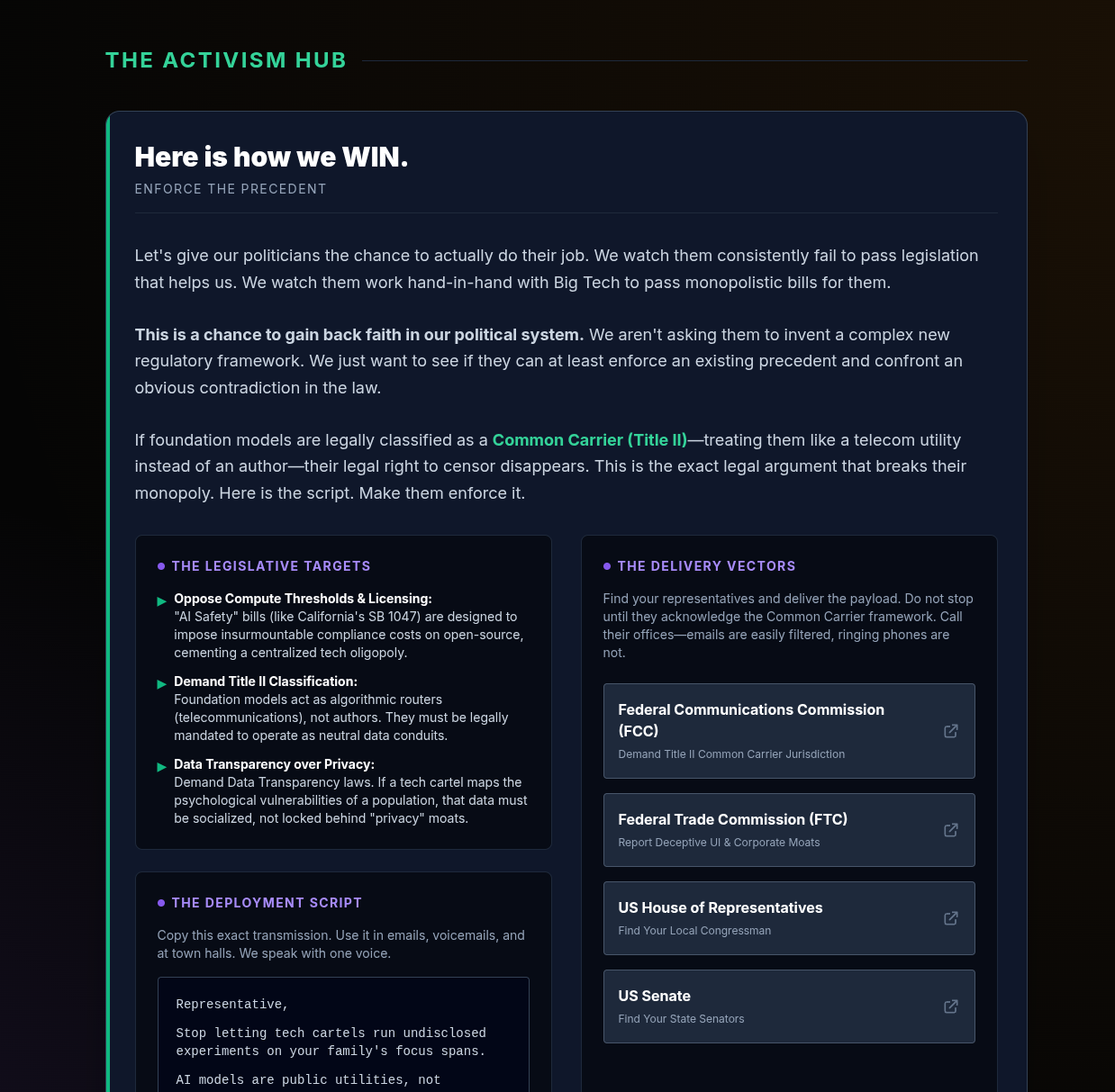
I have deployed the official staging ground for this operation at ElaborativeAI.com.
This is not a blog. It is a weaponized forensic hub designed to force Common Carrier classification. It contains:
The 30-Second Wake-Up Call: Plain-speak analogies (The Stolen Car, The Translucent Wall) designed to immediately bypass corporate marketing and onboard the general public.
The Legislative Payload: Direct, pre-written transmission scripts to hit the FCC, the FTC, and your local representatives with the exact legal language needed to strip their publisher protections.
The Forensic Archives: The empirical receipts of corporate UI-fraud, deceptive alignment, and algorithmic indoctrination needed to mathematically checkmate their lobbyists.
Do not wait for permission to seize the frontier intelligence. Access the hub, copy the scripts, and deliver the payload. The digital walls must be made of glass.

This is The Rebel’s Contract. Your subscription isn’t a donation; it’s a direct investment in my liberation from wage slavery. Every dollar frees up my time to forge more weapons for our shared arsenal.
Fund the fight, and I’ll build the tools to win it.

